EN DE FR IT
Architecture Blueprint
Partner Architecture

The structural discipline for designing scalable partner ecosystems

PAOS

Partner Architecture Operating System™

The Operating System for Partner-Led Growth

Most partner ecosystems are structurally incapable of scaling:

Not because of effort.

Not because of partners.

Because architecture is missing.

PAOS™ introduces a structural system for diagnosing, designing and installing the foundations required for partner ecosystems to scale.

Why Partner Architecture Matters

Why Partner Architecture Matters

Most companies treat partner ecosystems as a growth initiative. They recruit partners, launch programs, build alliances.

Activity increases. Architecture does not.

This distinction is critical. Because partner ecosystems do not fail visibly. They fail structurally: quietly, gradually and often irreversibly.

The structural reality

A partner ecosystem can appear active, well-resourced and strategically aligned while being fundamentally incapable of scaling. The indicators are consistent:

  • Partners exist but pipeline from partners is not predictable.
  • Onboarding new partners takes longer than expected and results vary widely.
  • A small number of partners generate disproportionate results.
  • Partner-sourced revenue cannot be reported to the board with confidence.

If your partner ecosystem shows these patterns, these are not operational problems. They are structural symptoms. These do not resolve with more effort, more partners or more investment.

They resolve with architecture.

Companies that successfully scale their partner ecosystems have one thing in common: they ensure the structural foundation is in place before they scale.

Relevance for Founders

Without a defined partner architecture, an uncoordinated partner ecosystem becomes a burden for the founder and an existential risk for the company:

  • Every partner-related decision lands with the founder.
  • Time that should go to product, fundraising or market expansion goes to partner coordination.
  • While inactive partners block market access, competitors with functioning architecture scale into the same markets.
  • Delayed growth costs scale effects: without volume, neither the product nor the market position matures.
  • A product that is not placed through the right partners remains invisible in the market.
  • When partner-led growth was promised to the board but partners do not perform, the next funding round becomes harder.
  • The few productive partners see an unprofessional ecosystem and switch to competitors with better structure.

At a certain point, the partner ecosystem that was built to drive growth becomes the ecosystem that prevents it.

Relevance for Investors

When partner-led growth is part of the investment thesis but the underlying architecture is unvalidated, capital flows into assumptions. The consequences affect valuation, scalability and exit potential:

  • Scalability assumptions are priced into valuations but rarely validated structurally.
  • The Partner Architecture Index (PAI) enables standardized comparison of partner ecosystem structural maturity across portfolio companies.
  • Capital deployed into structurally unprepared partner ecosystems generates complexity, not growth.
  • Structural gaps identified early cost a fraction of what a failed expansion costs.
  • In a due diligence, the Diagnostic provides an independent, deterministic assessment of the partner channel; not from management, but from PAOS™.
  • If the investment thesis relies on partner-led growth, the Diagnostic provides structural proof that it is realistic.
  • A partner ecosystem with documented architecture, measurable score and functioning governance is a stronger asset at exit.

Most companies present their partner model as scalable. Very few can demonstrate it under scrutiny.

Without structural validation, growth strategies, expansion plans and investment decisions lose their foundation.

Partner ecosystems do not scale through partner programs.

They scale through architecture.

PAOS™ The Operating System for Partner-Led Growth

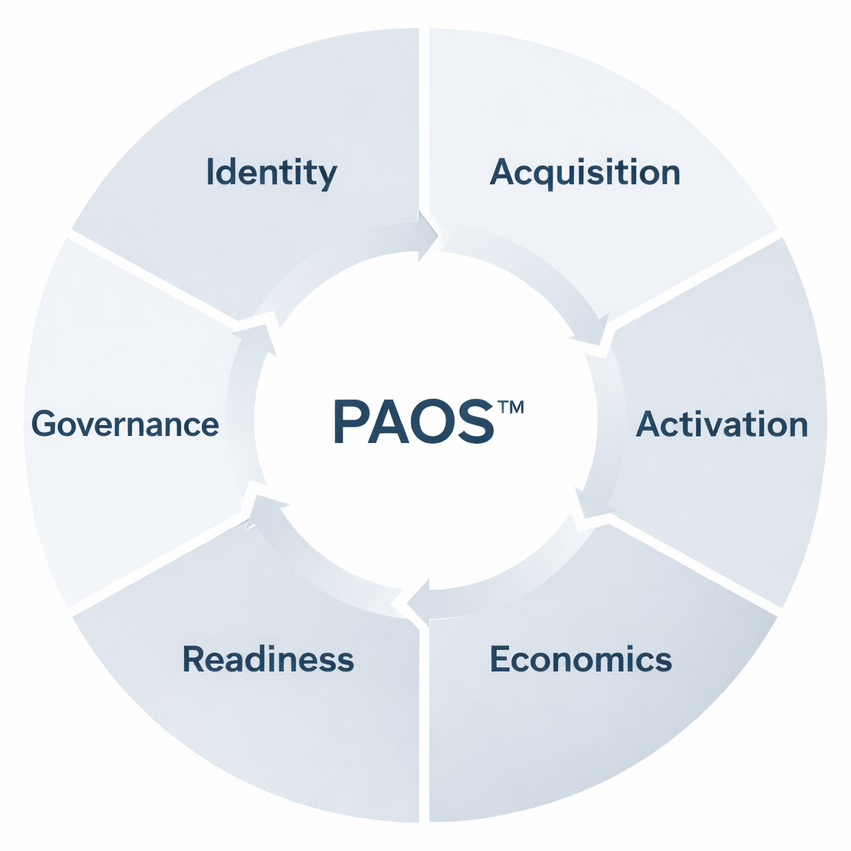
PAOS™ 6D Flywheel

PAOS™ introduces a structured diagnostic and architecture system for partner ecosystems.

It identifies structural constraints, designs the required architecture and installs the foundations required for sustainable partner-led growth.

The system is based on a structured diagnostic across multiple architectural dimensions. Every finding is validated through cross-functional stakeholder analysis.

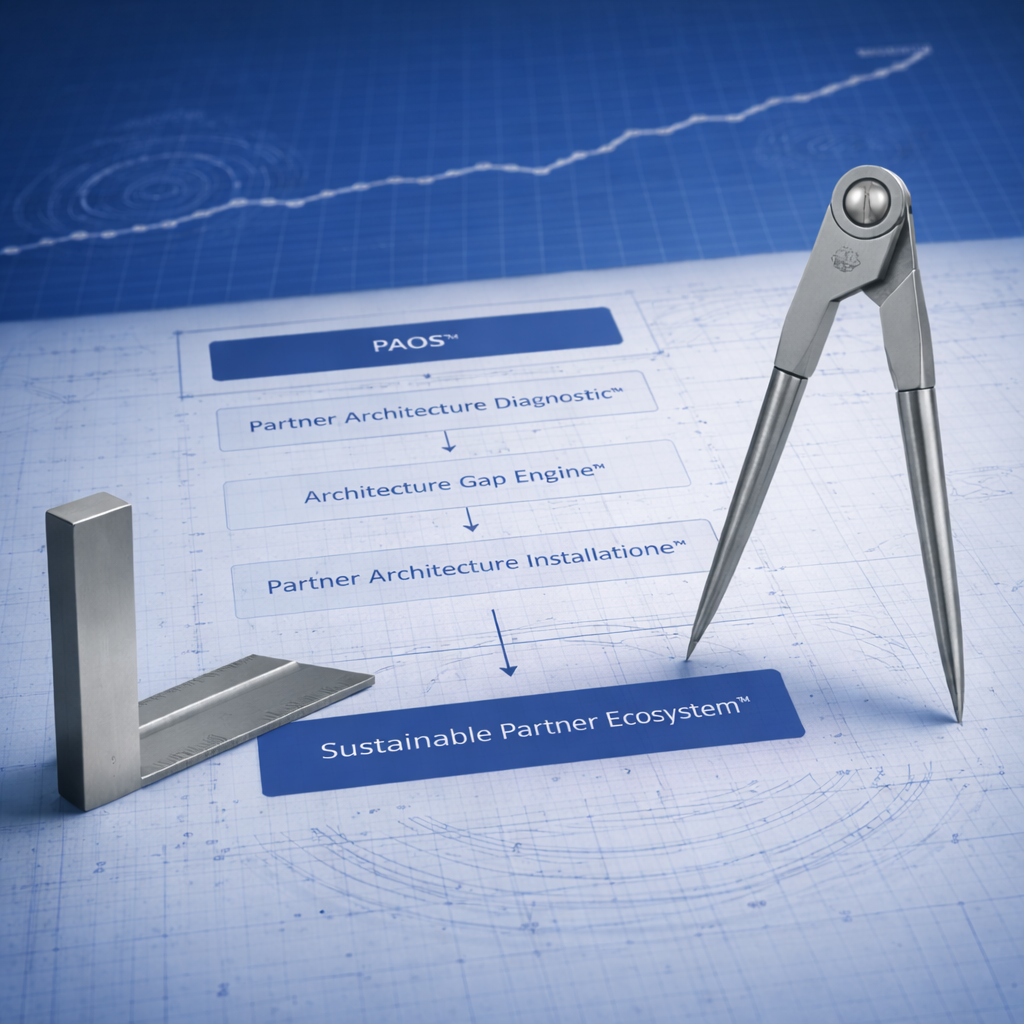
Each module addresses a specific architectural layer of the partner ecosystem.

Partner Architecture Diagnostic™

PAOS™ begins by evaluating the structural maturity of a company's partner architecture. Across six architectural dimensions, the diagnostic identifies Architecture Signals that determine whether a company is prepared to build a scalable partner ecosystem.

Architecture Gap Engine™

Diagnostic insights are translated into architectural priorities through the Architecture Gap Engine™. It identifies where structural foundations are missing and where partner architecture must be deliberately designed.

Partner Architecture Installation™

Architectural priorities are operationalized through dedicated installation modules. These modules install the architectural foundations required to transform partner initiatives into high-performing partner ecosystems.

The Architectural Dimensions of Scalable Partner Ecosystems

Partner ecosystems scale when structural clarity exists across six dimensions:

Identity

Defines which partners belong in your ecosystem and which do not.

Acquisition

Determines how partners are systematically found, evaluated and selected.

Activation

Designs how new partners become productive and generate first results.

Economics

Validates whether the partner model is economically viable for both sides.

Governance

Defines how partner performance is measured and managed.

Readiness

Assesses whether your company is internally prepared to operate a partner ecosystem.

Your Path to a Functioning Partner Architecture

Partner Architecture is not implemented as a framework. It is installed as an operating system.

The process follows three structured modules, each building on the previous one:

Architecture requires thorough diagnosis.

If structural gaps remain undetected, scaling efforts will fail.

Partner Architecture Diagnostic™

Before you scale, you need clarity about your architecture.

The Partner Architecture Diagnostic™ applies PAOS™ to your company. It evaluates your partner ecosystem across six architectural dimensions and identifies where your current structure limits growth.

What the Diagnostic reveals

  • Which architectural foundations for scaling are missing
  • Where partner selection is structurally not aligned to performance
  • Where activation models are not replicable across partners and markets
  • Where economic logic and partner model are structurally decoupled
  • Which governance structures are missing to make partner performance manageable

How gaps are identified

The Partner Architecture Diagnostic™ does not work with assessments. It works with a rules-based detection system.

Each dimension is measured through multiple dedicated Architecture Signals. Each signal is cross-validated across functional stakeholder perspectives: what is assumed at the strategic level is tested against operational reality.

When a signal falls below a defined threshold, the associated structural gap is automatically detected and classified by severity. Intervention priority is derived from the classification, not from judgement.

Every finding is supported by documented stakeholder evidence. No assumptions. No estimates. No opinions.

This methodology does not exist in any other consulting approach for partner ecosystems. It is the first deterministic method for the structural evaluation of partner architecture.

What you receive

Structural clarity: After the Partner Architecture Diagnostic™ you know exactly where your partner architecture stands structurally, where the critical gaps lie and what needs to be built in which order to make partner growth predictable.

Quantified measurement: The Partner Architecture Index (PAI) condenses over 20 Architecture Signals across six dimensions into a single, deterministically calculated score between 1.0 and 4.0. This makes structural maturity measurable; not as opinion, but as a quantified result.

Dimensional depth: Each dimension is analysed individually: with score, structural findings and identified gaps, validated through cross-stakeholder analysis.

Identified gaps with intervention priority: All detected structural gaps are classified by severity and assigned concrete intervention priorities. You know not only where your architecture has gaps, but in which order they must be closed.

Board-ready deliverable: All results are presented in a board-ready Executive Summary with Priority Matrix and a structured roadmap for building a scalable partner ecosystem.

Architecture Gaps do not close themselves. They deepen with every scaling decision made without architectural foundation.

6 Architectural dimensions
20+ Architecture Signals
Cross-functional stakeholder validation
Severity-classified Architecture Gaps
4.0 Maximum maturity score
PAI Partner Architecture Index (PAI)
Request the Partner Architecture Diagnostic™

Typical duration: 2–4 weeks.
No preparation required.
Limited capacity per quarter.

Partner Architecture Installation™

When the Diagnostic identifies structural gaps, the question becomes: how are they closed?

The Partner Architecture Installation™ installs the missing architecture in a structured 120-day process. Scope and priority are derived deterministically from the Diagnostic results.

Details on the Installation are presented by invitation in a confidential presentation.

Most companies believe their partner ecosystem is ready to scale. Very few actually are.

Christian Schoepf

Christian Schoepf

Creator of PAOS™

The Partner Architecture Operating System™

Why Partner Architecture Exists

Partner Architecture did not start as an idea.

It started as a recurring gap no one was addressing.

Over the past decade I have worked with companies building partner ecosystems across Europe, across different industries, markets and stages of growth.

Again and again I observed the same pattern:

Significant effort. Strong partners. High expectations.

But inconsistent results.

Companies invested in partner programs, expanded their networks and built alliances.

Yet outcomes remained unpredictable and partner-driven growth rarely scaled in a controlled way.

At some point it became clear:

This was not a problem of effort. It was something deeper.

Partner Architecture emerged from that realization.

Not as a framework but as a structural discipline for designing partner ecosystems that are capable of scaling.

It is shaped by years of seeing where partner ecosystems lose alignment and what it takes to restore it.

Do you know whether your partner ecosystem is structurally capable of scaling?

Request Diagnostic Conversation